
Since 1 January 2026, an acquisition that meets the Australian Competition and Consumer Commission (ACCC) notification thresholds must be notified and approved, or granted a waiver, before it completes. Approval depends on evidence.
The ACCC expects that evidence upfront. It wants a market definition, market share estimates and three years of acquisition history. An incomplete filing can leave a deal without an effective notification date.
Private equity is firmly in view. In October 2026, the ACCC reported that a significant number of acquisitions involved private equity firms or investment funds. Several appeared to be roll-ups of smaller businesses in the same industry.
Most guidance on the new regime answers one question: do you need to notify? This article answers the next one. What evidence does a notification need, and who builds it?
Key Takeaways
- From 1 January 2026, acquisitions above the ACCC’s notification thresholds must be approved, or granted a waiver, before completion. Completing without notifying can lead to penalties of up to $100 million and court orders voiding the deal.
- An ACCC merger notification requires a market definition, market share estimates with their data sources, and three years of acquisition history. It also requires contact details for competitors, customers and suppliers.
- The ACCC checks notifying parties’ market claims by speaking directly with customers and suppliers.
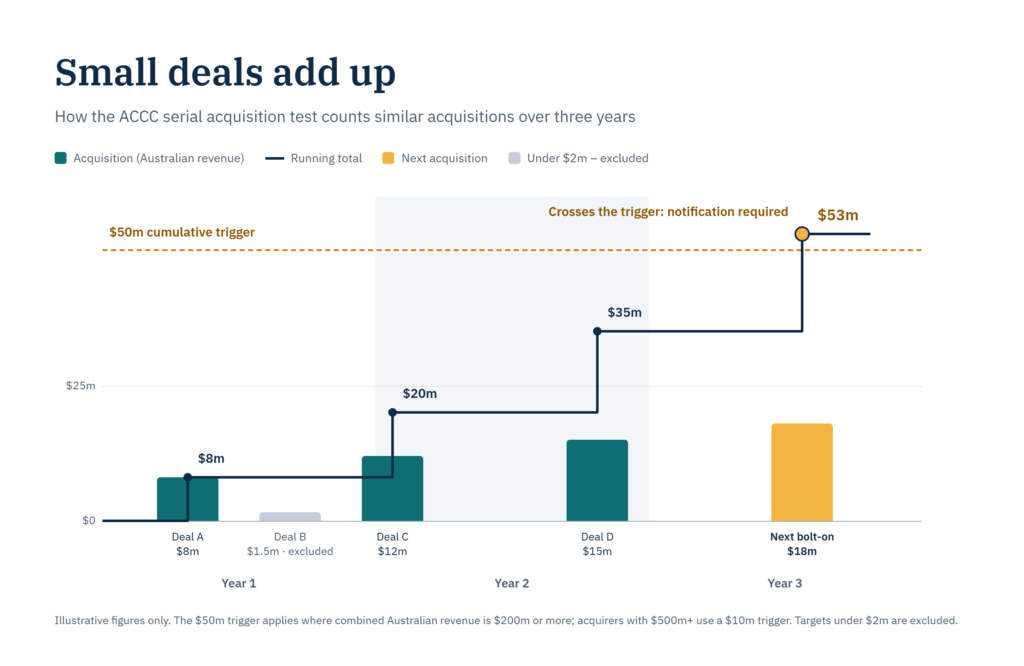
- Private equity roll-ups face added exposure under the serial acquisition test, which counts similar acquisitions over the past three years against a cumulative $50 million trigger ($10 million for very large acquirers).
- Weak market evidence can lead to the wrong notification form, an ineffective notification date, or delays.
What Acquisitions Need to Be Notified to the ACCC?
An acquisition must be notified when it meets the ACCC’s monetary thresholds and no exemption applies. The core test starts with the combined Australian revenue of the merger parties, which must be at least $200 million.
On top of that, the target must have at least $50 million in Australian revenue, or the global transaction value must reach $250 million. A separate threshold applies to very large acquirers. It is met when the acquirer has $500 million or more in Australian revenue and the target has at least $10 million.
A separate serial acquisition test looks back three years. Where the merger parties’ combined Australian revenue is at least $200 million, notification is required once acquisitions of the same or substitutable goods or services over that period reach $50 million in Australian revenue. For acquirers with $500 million or more in Australian revenue, the cumulative trigger is $10 million. Targets with less than $2 million in Australian revenue are left out of that count.
The stakes are high. Since 16 September 2026, a notifiable deal completed without notification is no longer automatically void. Instead, the ACCC can ask the Federal Court to declare it void or order other remedies, such as divestiture. A deal that was notified but completed before approval is still automatically void. The maximum penalty for a company is the greatest of three amounts: $100 million, three times the benefit obtained, or 30% of adjusted turnover during the breach period where the benefit can’t be measured.
Why a Notification Is an Evidence Exercise
A notification succeeds or stalls on the quality of its market evidence. The ACCC does not accept the parties’ view of the market at face value. It tests that view with customers, suppliers and competitors.
ACCC Chair Gina Cass-Gottlieb made this point in a speech at the Australian Competition Summit in Sydney on 15 October 2026. She said parties often claim their deal raises no competition issues. Conversations with their customers or suppliers then show issues worth investigating.
That testing affects timing. The ACCC committed to deciding around 80% of acquisitions within 15 to 20 business days, through either an early Phase 1 decision or a waiver. In FY26, it decided 92% within 20 business days. That pace depends on complete information. If the information is insufficient, the ACCC can find there was no effective notification date.
The obligation continues after lodgement. Parties must tell the ACCC about material changes during the review, such as a major competitor entering or leaving the market. Many deal teams already use business intelligence services & solutions to track their sector, and that monitoring now has a regulatory purpose.
What Information Does the ACCC Need for a Merger Notification?
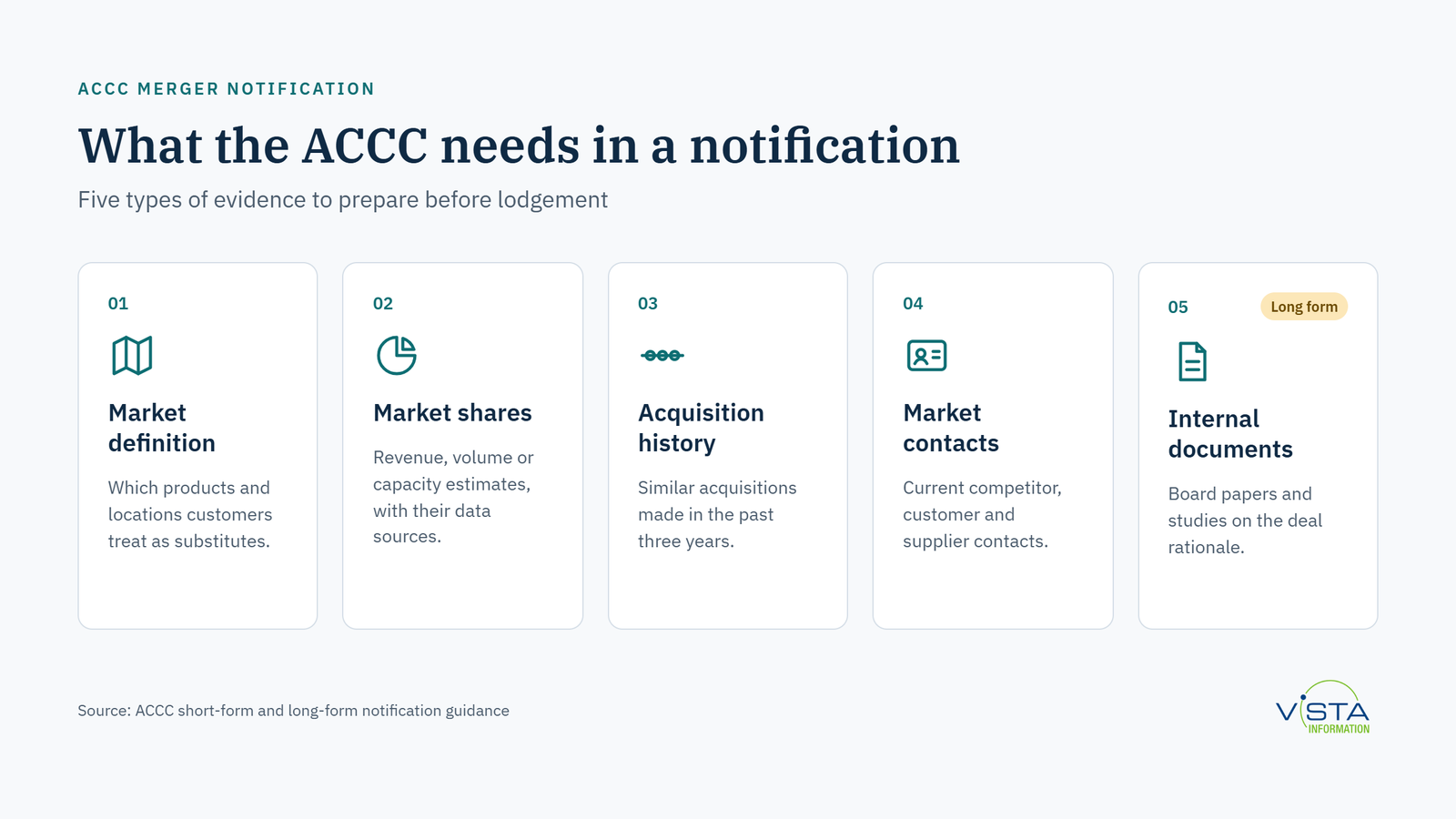
The ACCC needs enough information to judge whether a deal is likely to substantially lessen competition. Both notification forms ask for this upfront. The ACCC even publishes spreadsheet templates for market shares, past acquisitions, and competitor and customer contacts.
Market definition
Market definition sets the boundaries of the analysis. It identifies which products and locations customers treat as substitutes. Every later figure in the notification depends on it.
Market share estimates and their data sources
Market shares show how concentrated a market becomes after the deal. Estimates can be based on revenue, volume or capacity. Long-form filings must also name the third-party datasets or reports behind each estimate and explain how the parties use them.
Three years of acquisition history
The forms ask for acquisitions made in the three years before notification. For a single company, this is a records task. For a sponsor with several portfolio companies, it becomes a research project.
Competitor, customer and supplier contacts
The ACCC uses these contacts to test the market. Accurate, current details help it complete its inquiries on time. Outdated lists slow the review down.
Internal documents and board papers
Long-form filings require board papers, studies and market research covering the deal rationale or competitive dynamics. These documents must match the market story told in the notification. Any inconsistency invites questions.
Notification Evidence Map
| Notification requirement | Research input | Typical sources |
| Market definition | Product and geographic substitutes, customer switching behaviour | Industry reports, trade publications, customer interviews |
| Market share estimates | Revenue, volume or capacity by competitor | ABS data, annual reports, ASIC financial filings, industry association data |
| Acquisition history (3 years) | Each similar acquisition, its date and Australian revenue | Deal records, ASIC company searches, portfolio company files, press releases |
| Competitor, customer and supplier contacts | Named, current contacts for key market players | Company records, industry directories, CRM data |
| Internal documents | Board papers and market studies on deal rationale | Data room, deal team files, prior consultant reports |
Short Form or Long Form: How Research Shapes the Choice
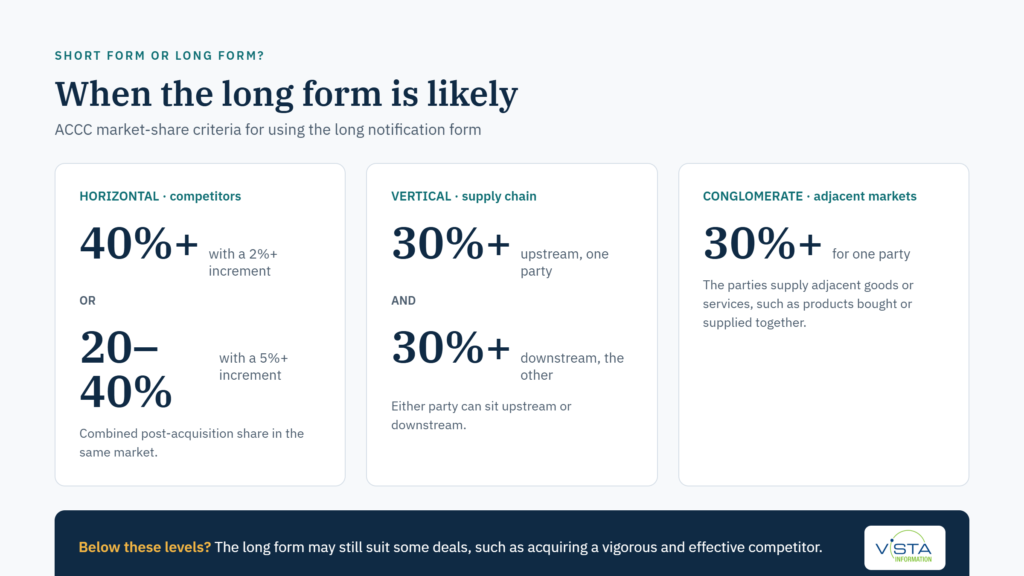
Market share estimates largely decide which form applies. The ACCC says the short form suits most straightforward deals. Its guidance says parties will generally need the long form where:
- Horizontal: the combined post-acquisition share is 40% or more with an increment of at least 2%, or 20% to 40% with an increment of at least 5%.
- Vertical: one party holds 30% or more in the upstream market and the other holds 30% or more downstream.
- Conglomerate: the parties supply adjacent products and one of them holds a share of 30% or more.
The long form may also suit deals below these levels, such as acquiring a vigorous and effective competitor. Parties should also test whether the criteria are met under the market definition that gives the largest share or increment.
Choosing the wrong form is costly either way. If parties file the short form and the ACCC finds the information insufficient, it can treat the notification as materially incomplete, with no effective notification date. It can also request more information and extend the timeline. Filing the long form unnecessarily wastes substantial effort. Reliable share estimates before pre-notification engagement reduce both risks.
The Serial Acquisition Problem for Private Equity Roll-Ups
Serial acquirers carry the heaviest research load under the new regime. Because of the three-year lookback, small deals can add up to a notifiable one. A bolt-on that looks immaterial on its own may trigger notification once earlier acquisitions are counted.
The ACCC is watching this closely. In the first nine months of 2026, it saw high rates of acquisitions in medical, dental and veterinary services. Aged care, hospitality and supermarkets also featured. A significant number of deals involved private equity firms or investment funds, including some that appeared to be rolling up smaller businesses.
The ACCC has pointed to the UK as a warning. From 2016 to 2023, a period of heavy consolidation of veterinary clinics, average vet prices rose by 63%.
For a sponsor, the practical task is reconstruction. Every relevant acquisition across the portfolio must be listed and its Australian revenue confirmed. Each one must also be tested for whether it involved the same or substitutable services. A specialist research consultancy in Australia can take this work off the deal team’s desk.
Can Research Support a Waiver Application?
Yes. A waiver removes the obligation to notify. In deciding, the ACCC weighs set factors, including how likely the deal is to substantially lessen competition. It needs enough information to judge that risk.
Waivers are common. From January to September 2026, the ACCC received 486 waiver applications and approved 410. It refused 21. The waiver fee is $8,300, compared with $56,800 for a notification (2026–27 fees). If a waiver is refused, the deal may still need to be notified, with a new fee. Clear market evidence gives a waiver application its best chance.
In-House Deal Team vs Specialist Research Support
Most deal teams can build notification evidence themselves. The real question is whether they should while a deal is live. For a single acquisition in a well-documented market, in-house work may be enough. The case for outside support grows with portfolio size, data gaps and deal pressure. Knowledge process outsourcing gives teams dedicated research capacity without adding permanent headcount.
| Factor | In-house deal team | Specialist research support |
| Time | Competes with live deal work | Dedicated capacity for the filing |
| Data access | Limited to existing subscriptions | Wider source coverage |
| Independence | Risk of confirming the deal thesis | Independent challenge to market claims |
| Rework risk | Gaps surface late, often after lodgement | Gaps surface before lodgement |
Getting the Evidence Right Before You Lodge
An ACCC merger notification is only as strong as the research behind it. Market definition, share estimates and acquisition history shape the form, the timeline and how the ACCC reads the deal. For private equity sponsors, the serial acquisition test turns that research into a portfolio-wide task.
The best time to build the evidence is before pre-notification engagement. Waiting until the ACCC starts asking questions costs time the deal may not have. Independent research also gives the law firms acting on the deal a tested base for the filing, which is where legal research support services add the most value.
Contact Vista Information to discuss how our desk research and commercial intelligence services can help your deal team build ACCC-ready market evidence before lodgement.